
Antique initials
Why do so many of the pieces I find have initials on them? Is it just that people wanted everyone to know who owned them? Well, yes it is, but there is more to it.

A preamble: if you have been following me for a long time, like years, you might recognise this piece as one that appeared on my old old website, the one before the one before the one I have now. I am reposting it because a. I think it bears reposting b. I am still deep in the throes of applying for French nationality and that is taking all the time I have outside work hours, and c. it is now the fourth week of insanely, hugely, terrifyingly hot temperatures, like sometimes double what the temperature should be at this time of year, and my atelier is on the second floor, under our uninsulated roof, and it is taking every ounce of my force to work up there, which I am doing because I have to always keep working, but I don’t have much energy left for anything else. I’m up at five to open all the windows, try to keep parts of the garden alive, walk the dog, and do any food prep, and then the rest of the day is just spent working in twenty minute increments and then coming down to drink ice water and sit in front of the fan. There is at least another week of these temperatures to go, and everyone in France is so exhausted and so tired of being inside all day every day because outside is actually, I am not kidding when I say this, currently hotter than the Sahara.
On this last can I say that if you ever wanted to buy a linen sheet, or a shirt, or anything, do feel free right now. I can’t do much ironing atm for obvious reasons but there are new pieces up on the website. There will be some more pieces slowly trickling up there, as I try to iron a couple of pieces in the relative cool of the morning.
And if anyone has a rich relative who would like to buy roofing insulation for an eccentric textile lady and her très adorable children and their rather long skinny hound-dog, please just mention me to them, we are open to all sorts of charity at this point, or even just words of commiseration!
Ok let me get on. I wish this was better-written. I wish I could find better examples to illustrate it. I still have imposter syndrome. No matter.
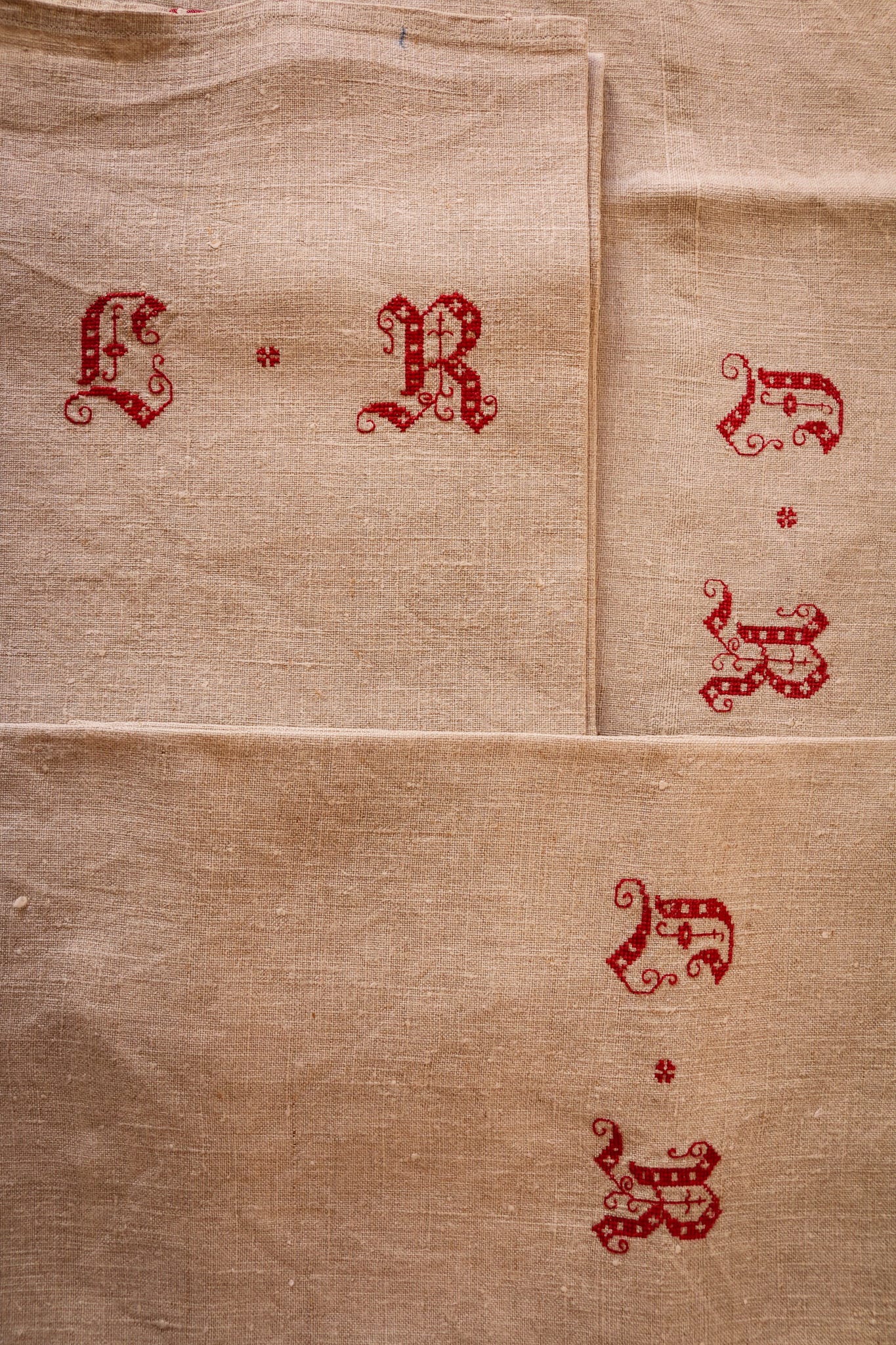
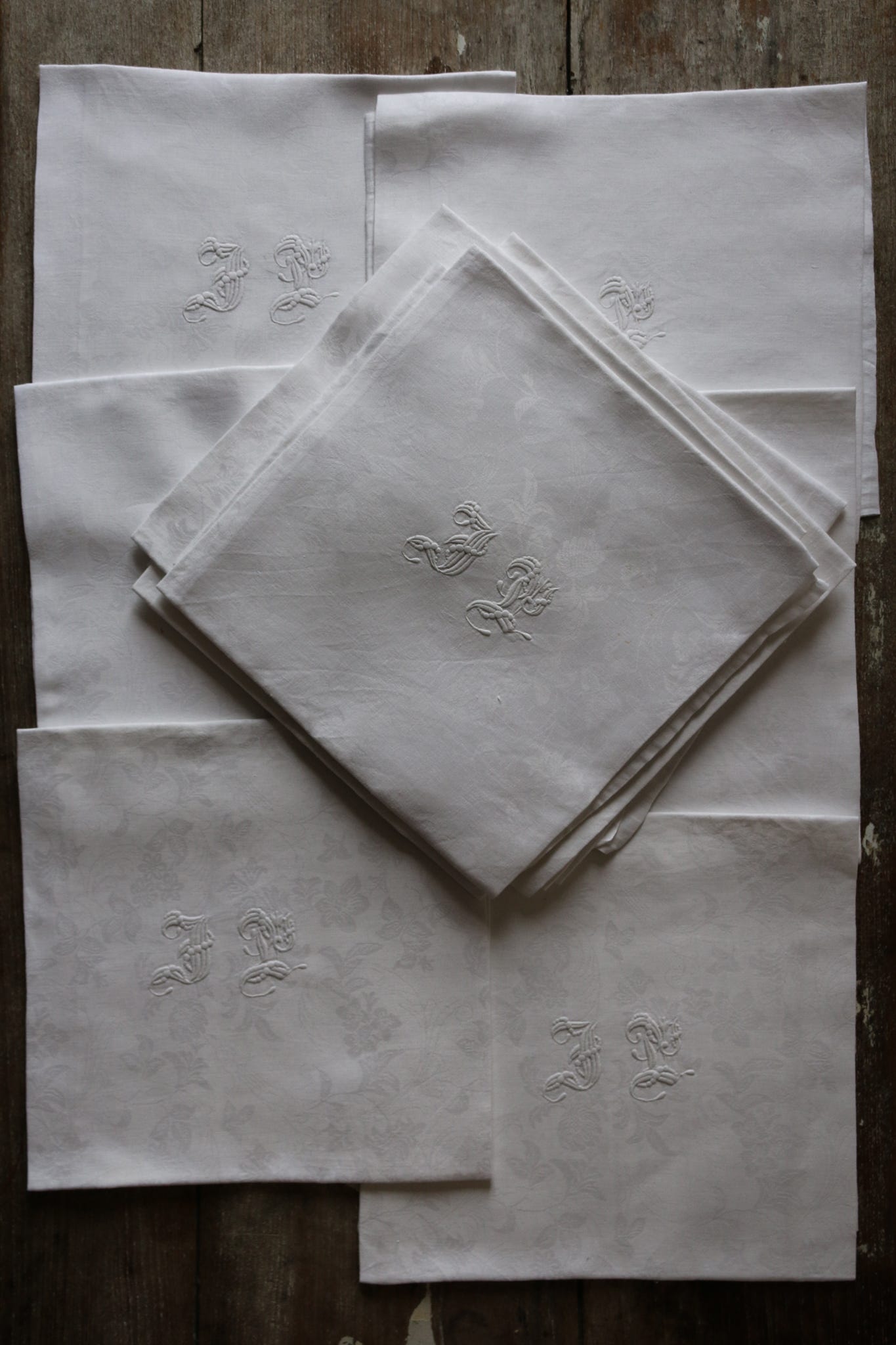
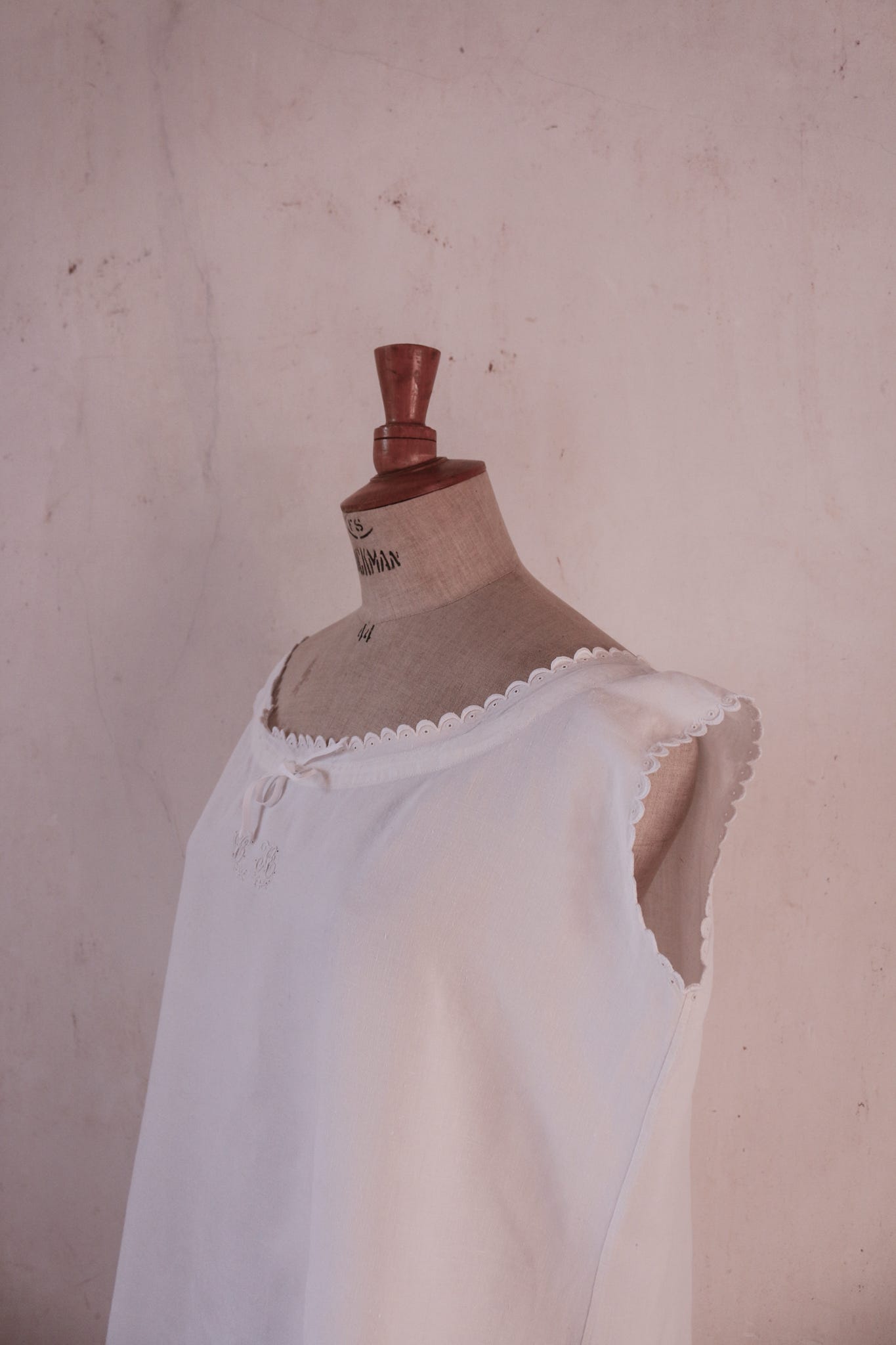
Many if not most of the household linens I find have initials embroidered or cross-stitched somewhere, be it in one corner, or the middle, or both sides. The method, placement and decoration of these initials tells you a great deal about both the owners and the original usage of the piece. The more intricate and delicate initials or monogrammes were, the more centrally-placed, the wealthier the original owner was. These types of initials, or more often monograms, carefully-designed patterns which incorporated the owner’s or family’s initials, were made purely to designate ownership and show off wealth. These pieces were valuable and expensive even in their own time, and until well into the 20th century they were included in summaries of the wealth of an estate, and formed part of inheritances. In the early part of Suite Française, written by Irene Nemirovsky, herself a French Jewish writer who was deported and died in Auschwitz in 1942, there is a description of a bourgeoise family fleeing Paris as the Nazis move in, and during the frenzy to pack the car and get everything valuable under cover, Madame Pericande remembers that the most valuable of the household linen has been left with the laundry, and instructs her maid to go and fetch it. The still-damp linen is bundled into the car as the family flee the city in search of refuge.
My current house is leased from the large manor house across the road [Note that I no longer live in this house, I now live in a much smaller and more manageable house that once belonged to a peasant farmer. It is less photogenic but damn the electricity bills are so much better] . The manor house, referred to in this small village as the Château, was built between the 17th and 19th centuries, and has a huge park and numerous caves. It stands on the site where a much older château, one dating from the 11th and 12th centuries, with white stone and turrets, stood until it burnt down in the late 18th century, an incident which I am told had nothing at all whatsoever absolutely to do with the Revolution. The family that owns the Château now has been there since their ancestor purchased the land after the original château so coincidentally burnt down right at a time when châteaux in this region were being burnt down fancy that. My proprietor and her sister are elderly (and I adore them!) and are sadly and probably the last of their family who will inhabit this place. They have told me amazing things. Growing up, there was a family of 12 and a staff of I don’t know how many, but it was a working farm and supplied all of its own needs, so the staff would have been considerable. Claire told me that there was a sit-down lunch and a sit-down dinner, both formal, involving tablecloths and serviettes for everyone present, the family and any guests, and that each time the linen was crisp and white and starched. And then she told me that wash-day was once a year, so it was more like wash-month, I imagine, but now you can see the enormous wealth involved for one of these grand houses, which must supply linens starched and perfect for at least 12 people twice a day 365 days of the year. And then there were the household bedlinens (I’m not including personal linens here although undergarments that I find frequently have initials embroidered on them as well). And then there were the staff linens.
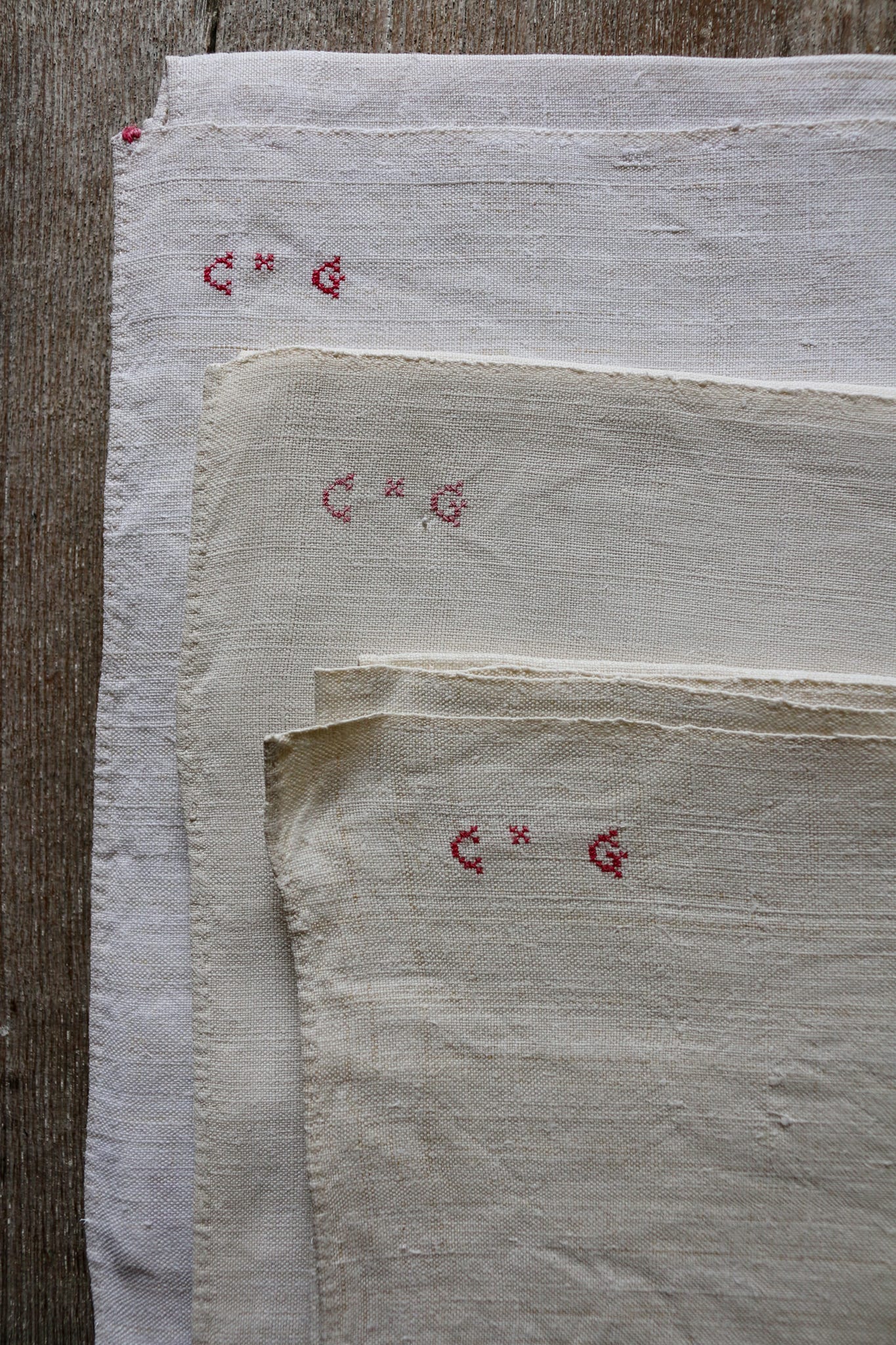
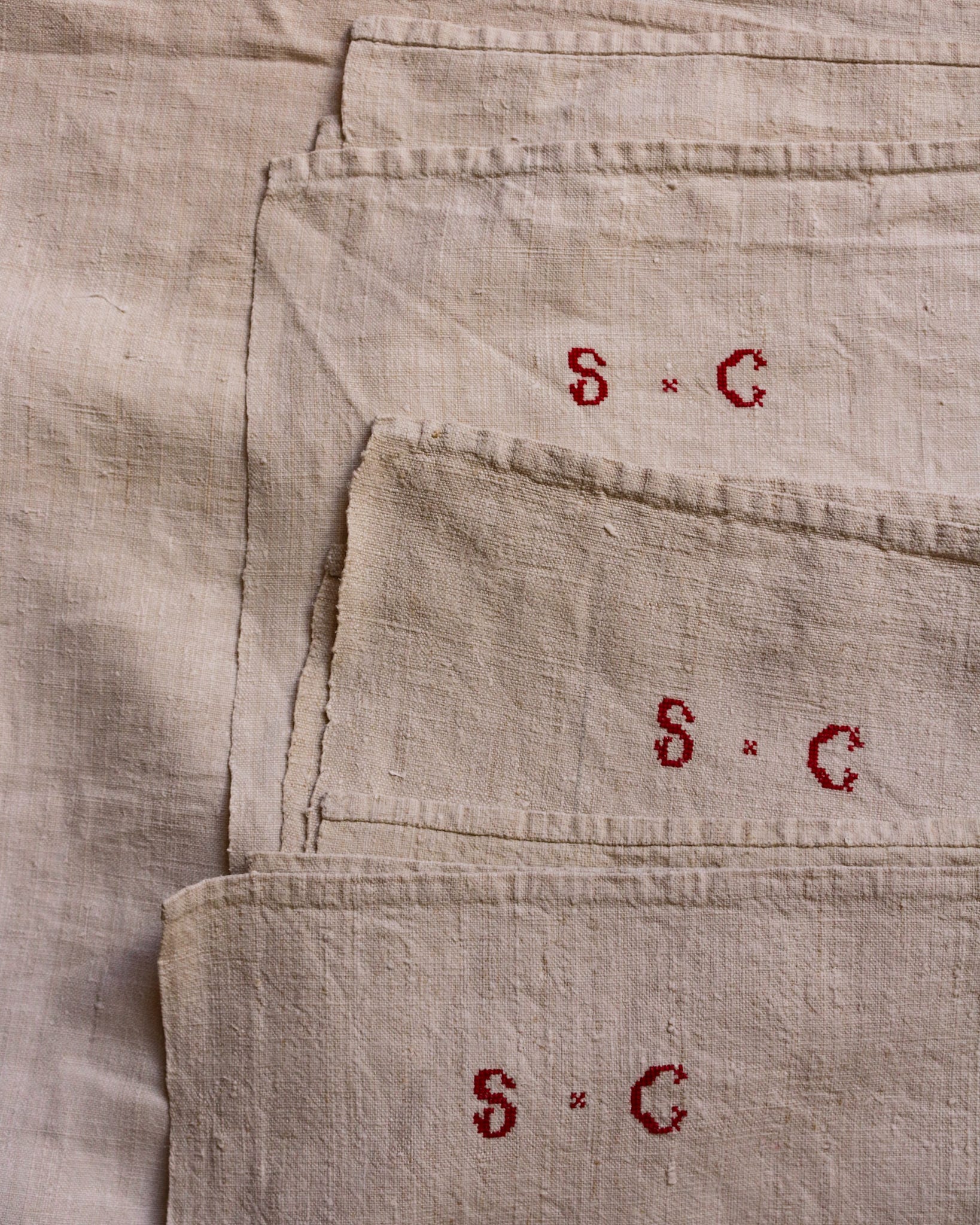
Claire’s description of wash-day explained to me why many of the pieces I find have numbers in the corners. Whilst the intricate monogrammes and hand-embroidered initials designated wealth, or at least some means, however scant, serving linen is most often found with red cross-stitched initials and frequently with numbers in the corner. These numbers represent how many pieces were in a set, so that, for example, if your wash month involved hundreds if not thousands of pieces, at the end, when the poor laundresses were ironing using a flatiron heated directly on the stove, and a large table covered in felt as an ironing board, they would know how many pieces of each were in a set, and at the end, everything would be tallied and stacked and put away in the enormous linen cupboards. The initials are red because red is the easiest to see against white. Claire showed me the linen cupboard for the family linen one day - it’s not a cupboard at all but an entire room lined with shelved cupboards.
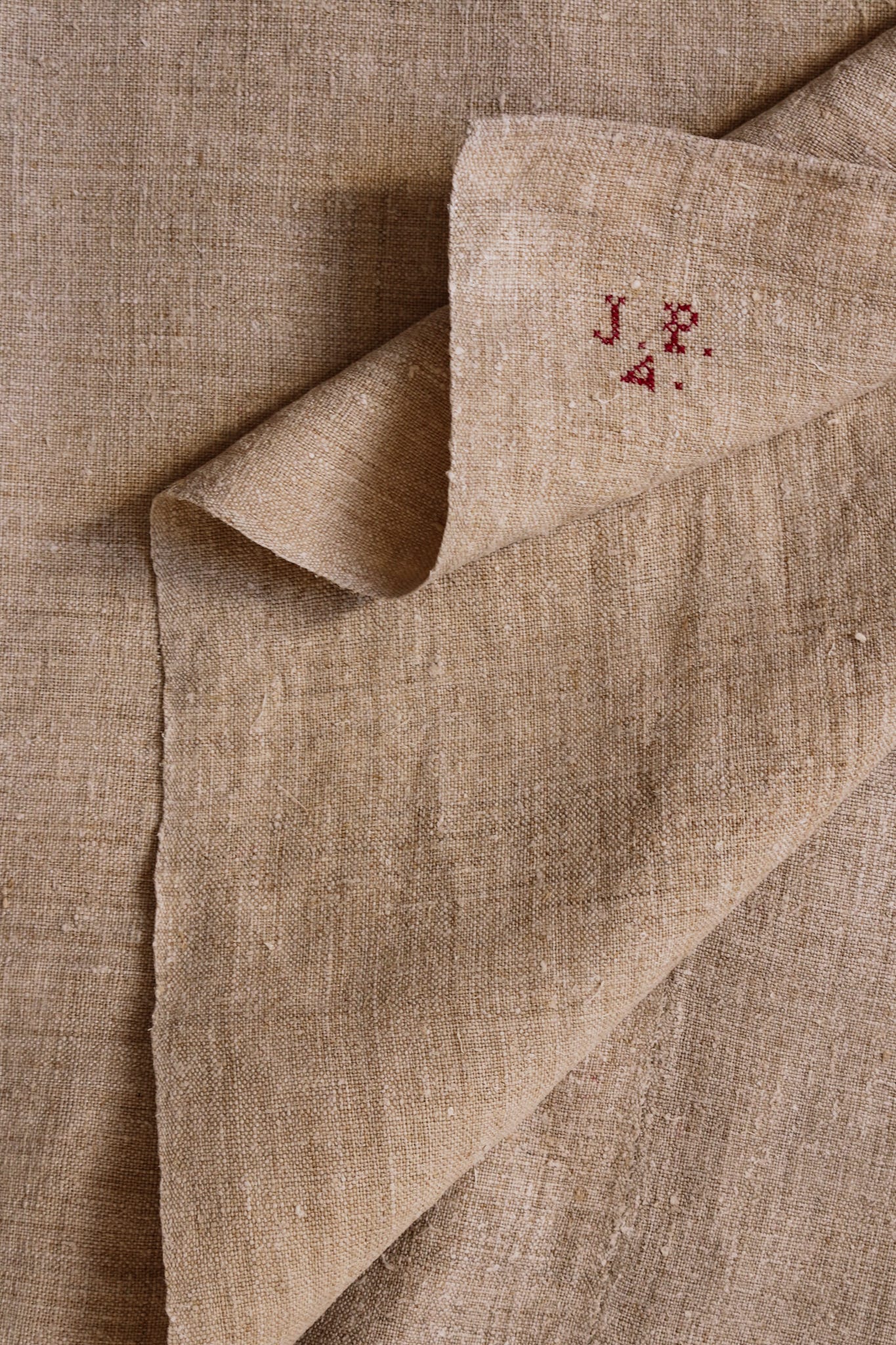
It wasn’t just serving linens for the wealthy that have these red cross-stitched initials in the corner. I also find them almost always on the farm-grown, handspun and handwoven hemp and linen tablecloths used on the vineyards here in the 18th, 19th and early 20th centuries, and on the handspun and handwoven sheets. This was more a case of marking ownership, during harvest there would be a large number of people working at any one time on the vineyards, often itinerant workers or neighbours, and these tablecloths would be spread out on the trestle tables to feed the armies of workers. You would want to keep tabs on your linen and hemp here too, because they represented a huge investment of time to grow, process, spin and weave. The value placed on these items can be seen by the respectful way in which many of them that fall into my hands have been repaired. It is even more obvious in the grain-sacks I find, made of the same handspun hemp, they frequently have beautiful repairs involving careful window patches. They were too precious to simply discard.
Here I must once again mention a BBC program presented by my personal goddess, Ruth Goodman, on life in Tudor times, in which she points out that it took more time and work to clothe a person in the clothes they needed for a year of four seasons than it did to feed that same person for a year.
The intricate monogrammes on the linens of wealthy households was very rarely done by anyone in the house. Instead, it was sourced out to piece-workers, highly-skilled women, very poorly paid, who would embroider these magnificent pieces, working often outside their cottages in all weather for the light it afforded them, as there would have been no electricity in their homes. For women living in times when there was no social security, and when many of their men-folk were killed or injured fighting in the wars that France was involved in from the 18th century onwards, this was one of the few ways they could earn enough to eat, especially whilst looking after young children. In an interview I saw from a short documentary made in the 1970’s, interviewing three very elderly women, all lacemakers, all in their late 80’s and early 90’s in the upper Loire, the interviewer asks at what age they began to learn. Six, seven, is the response, and there wasn’t a choice; the family needed to eat, school came second for these girls. The interviewer asks how much money they were paid, and they give him a side-eye and refuse to directly answer the question. Enough, is the response. The whole time they are speaking, their hands are flying over the tiny lace-making bobbins, creating intricate fine lace without seeming to even look.
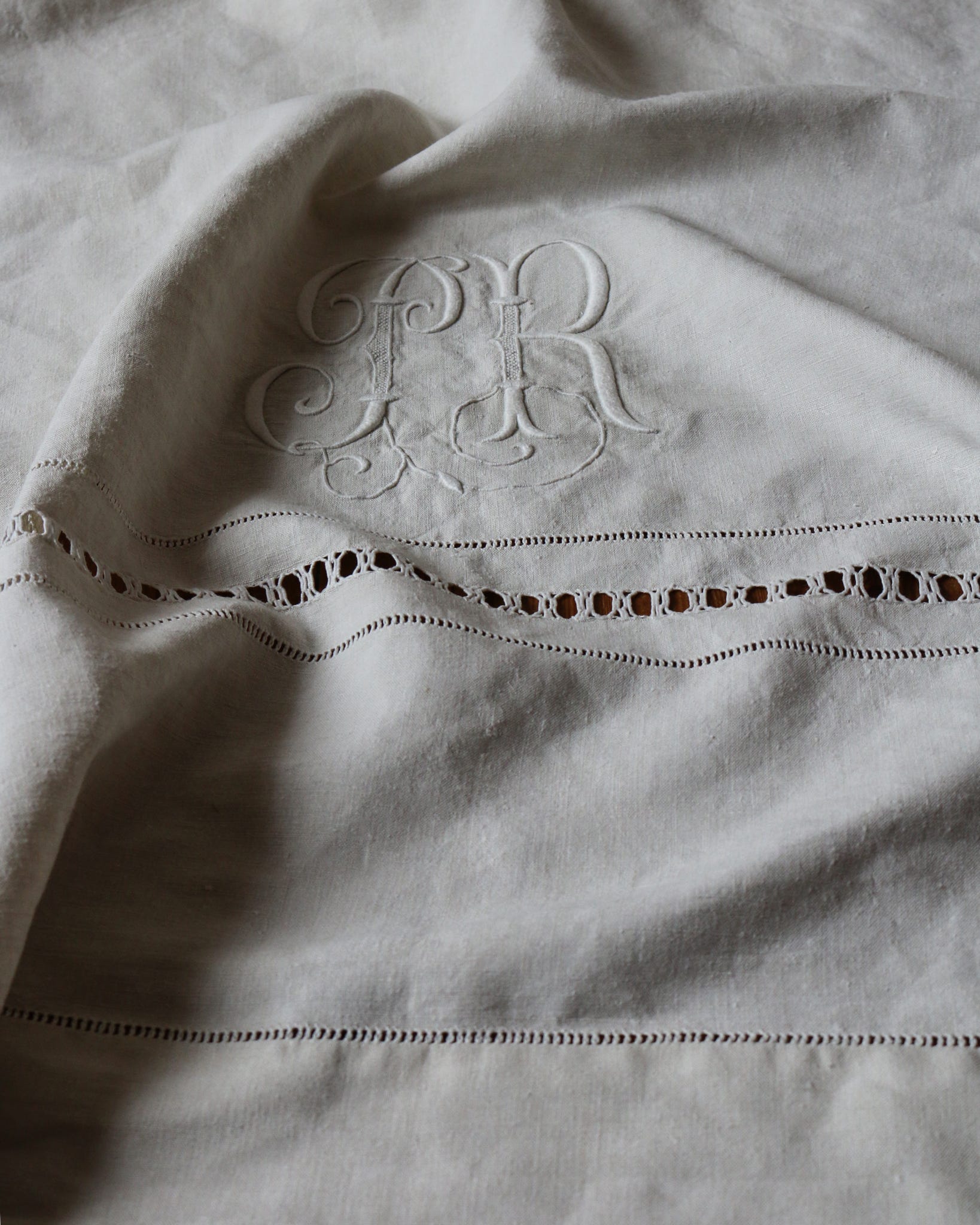
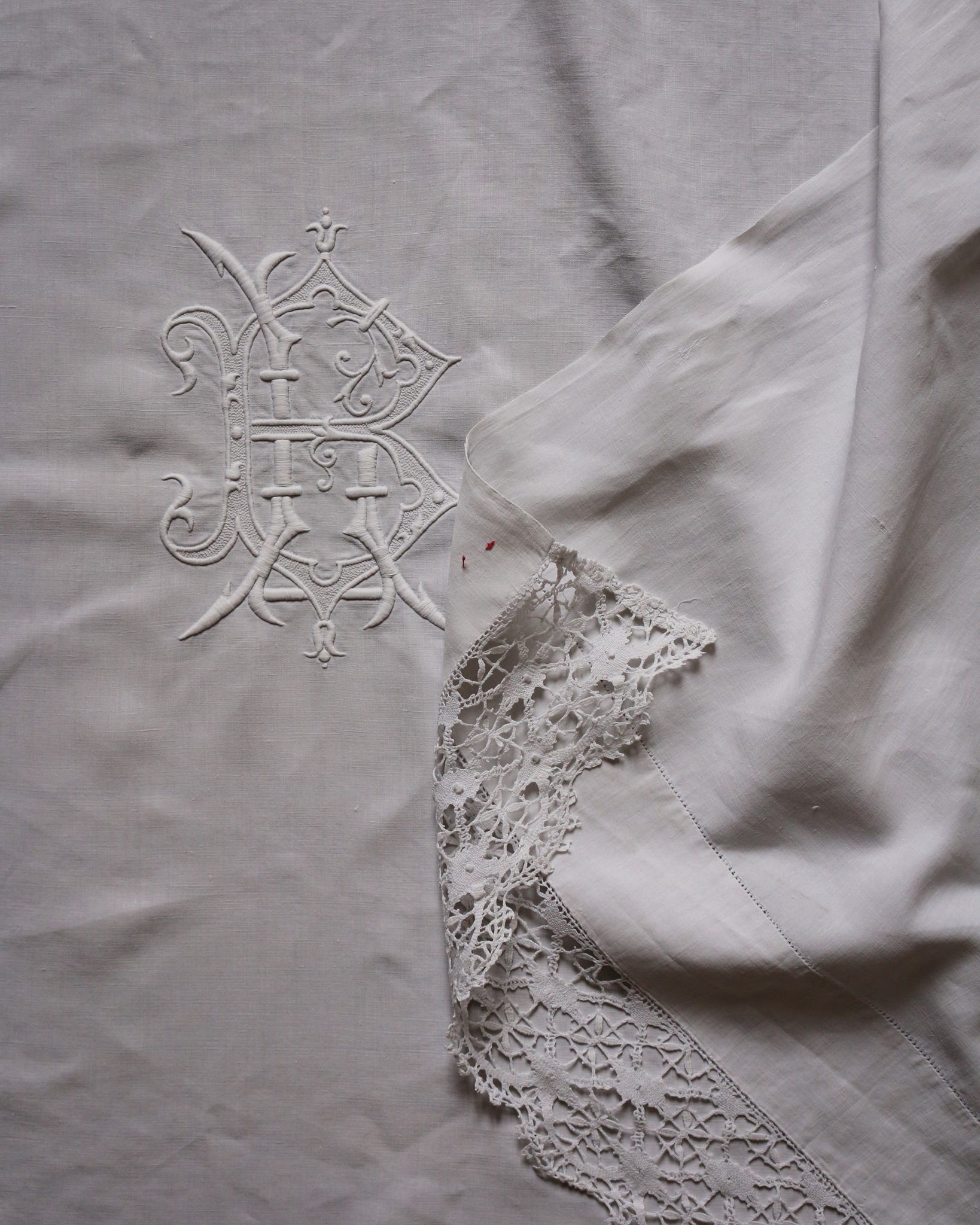
After the First World War, with its fantastic loss of life and devastation of so many rural households, embroidery became even more important for rural women. It wasn’t until the aftermath of the Second World War and the emergence of a beginning of social security that this kind of poorly-paid piece-work began to disappear. I’m not sad it’s gone, as much as I marvel at the skills of these women, I hold always an enormous respect also for their bravery and their courage in doing what had to be done, in conditions which must have often been tough and which barely earnt them a living wage. When I hold a piece of very fine linen with very intricate embroidery, my mind doesn’t turn to the owner, it turns always to the embroiderer. They were very rarely the same person, and the romantic notion of a young wealthy woman making up her trousseau does not fit the reality when you can see above that a large household would have used hundreds of these pieces in a year. This is not to say that young women never embroidered their trousseaux, but the majority of pieces I find which I think fall into this category of embroidered linens were done by farm girls or lower middle-class women, I can tell from both the quality of the embroidery and the quality of the fabric used. Upper-class women would have more likely spent their time embroidering something purely decorative and very delicate. I love these rustic trousseau pieces when I find them, I always think I can feel their energy and care from someone whose hope in life was for a family, a safe place, food in their bellies and a fire in the hearth. I have this same hope, always, I think of them in comfort.
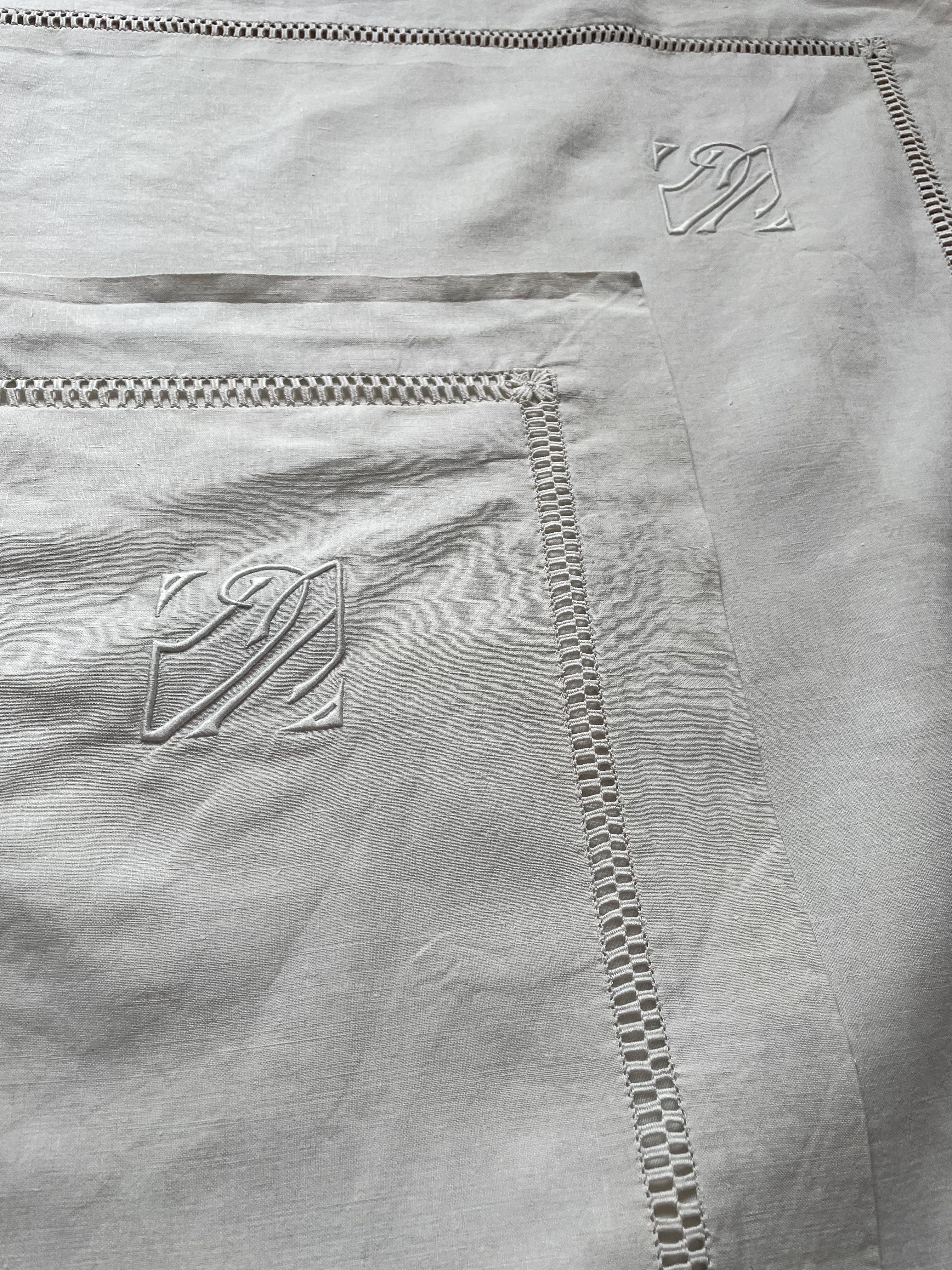
Towards the late 19th century, the rise of semi-industrialised piece-work meant that you could go and buy trimmings from places like Le Bon Marché, and so you didn’t need to engage someone in person. Nevertheless these trimmings were mostly hand-done, and I find not a few of them with their original labels still intact, all completely handworked. Occasionally I also find pre-embroidered initials, often very beautiful, but quite simple. You would buy the necessary initials and then employ someone, or even yourself if you were handy with a needle, which in the 19th century everyone was, even men, to tack them securely onto the linen, and bingo, instant embroidery! There is also a standardisation from this time of professional businesses of embroiderers, which is probably related to the work becoming more of an outsourced job where once it would have been done by a skilled in-house maid, as I find the same patterns and initial design repeated over and over again in linens dating from around 1910-1930. You would buy the fabric for the sheets, and then take it to a business which specialised in sheet-making and embroidery, and choose the design from a book. The design would then be stencilled onto the linen and embroidered for you at the same time as the sheet was hemmed.
From the mid to late 19th century Le Bon Marché also sold pre-stencilled ready-cut pieces of linen which were aimed at the lower middle class women making their own underwear or embroidering their own sheets. These are often in what was considered second-class linen or cotton, but which today is of better quality than anything we have available, so far have textile standards fallen. All of the above meant that in the first decades of the 20th century there was a slight democratisation of embroidered linens, but not too much. All the work was still done by hand, and those hands were not paid at all well.
I get asked a lot for particular initials, a request which I can’t often fulfil as it is simply too difficult to keep tabs on such requests and the time required to propose individual pieces is not possible. For me personally, although I do have a couple of pieces with my initials (including a lovely huge damask tablecloth and its complete set of 12 serviettes), I just am always moved that someone, rich or poor, took the time to mark these linens so beautifully, because it is a tangible reminder of how much textiles were valued, even 60 years ago, and this is something I am continually advocating for and that I wish we would return to. But if we are to deduct the exploitative labour component we must become far more realistic about how much we need to own, and about the time and labour and skill it takes to make things, even machine-woven or stitched things. Yet again a reminder to think carefully about your cloth.
If you liked this post, please consider sharing it! xx Hanna
Always so intereting to read your article, Hannah!
By the way, I received my lovely indogo-dyed shift! It's so beautiful. But I'd forgotten there were no buttons! So I'll have to find ones soon to sew them on and be able to wear it this summer.
Hi Hanna,
Good to read your words of linen and it's creation and use again. Thanks for finding the time in that life destroying heat you've had (I hope it's now all in the past).